
An odds percentage calculator is a digital tool that converts the ratio of favorable to unfavorable outcomes (odds) into a percentage. This percentage represents the implied probability of an event occurring. To use it, you input the odds, and the calculator provides the equivalent percentage chance of that outcome.
Have you ever looked at betting odds or statistics and felt confused? It can be tough to figure out what they really mean. Turning odds into a probability (and back again) is a useful skill. But doing the math by hand is tricky and it’s easy to make mistakes. This can lead you to misunderstand the actual chances of something happening.
That’s why we created eLearnSmart. Our goal is to make complicated topics easy to understand with simple, powerful tools. We offer more than 100 free professional calculators, including our Free Odds Percentage Calculator. This tool instantly converts odds into a percentage, so you can see the actual probability without needing to remember any formulas. It’s a great tool for students, analysts, bettors, and anyone who wants to understand statistical likelihoods.
Forget about guesswork and confusing equations. Our odds percentage calculator makes it easy. In this guide, we’ll show you exactly how to use this free tool to find the implied probability in seconds. You’ll learn how to enter your values, read the percentage result, and understand the basic difference between odds and probability. Let’s get started and see how simple it is to use our free odds percentage calculator.
How to Use the Free Odds Percentage Calculator

Input Your Odds
Our free odds percentage calculator makes it simple to convert odds. First, find the input section of the tool. You will see several options for entering your odds.
The calculator supports common odds formats, including:
- Fractional Odds: Enter as a fraction, like 7/2 or 5/1.
- Decimal Odds: Input as a decimal number, such as 3.50 or 1.80.
- Moneyline Odds: Use a plus or minus sign, for example, +200 or -150.
Simply choose your preferred format and type the odds into the field. Our tool handles the math for you, ensuring you get fast and accurate results from the odds percentage calculator.
Understanding the Percentage Result
Once you enter your odds, the calculator instantly shows the percentage. This number is the implied probability of an event happening. It turns abstract odds into a simple figure.
For example, if you enter 2/1 fractional odds, the calculator shows 33.33%. This means there is a one-in-three chance of that event happening. Similarly, decimal odds of 2.00 equal a 50% implied probability. Understanding implied probability helps you make better decisions [1].
This percentage gives you a clear number. It lets you compare different events and helps you understand the real likelihood an event will happen. This is very useful in areas like sports betting or risk analysis.
Resetting for a New Calculation
After you get a result, you may want to start a new calculation. Our odds percentage calculator has an easy reset button. This clears your last entry and readies the tool for the next one.
Look for the “Reset” or “Clear” button. One click will return the calculator to its starting state. This gives you a fresh start every time, saving you time and effort. This simple feature makes it quick and easy to compare multiple odds.
What is the Difference Between Odds and Probability?
Defining Odds: The Ratio of Outcomes
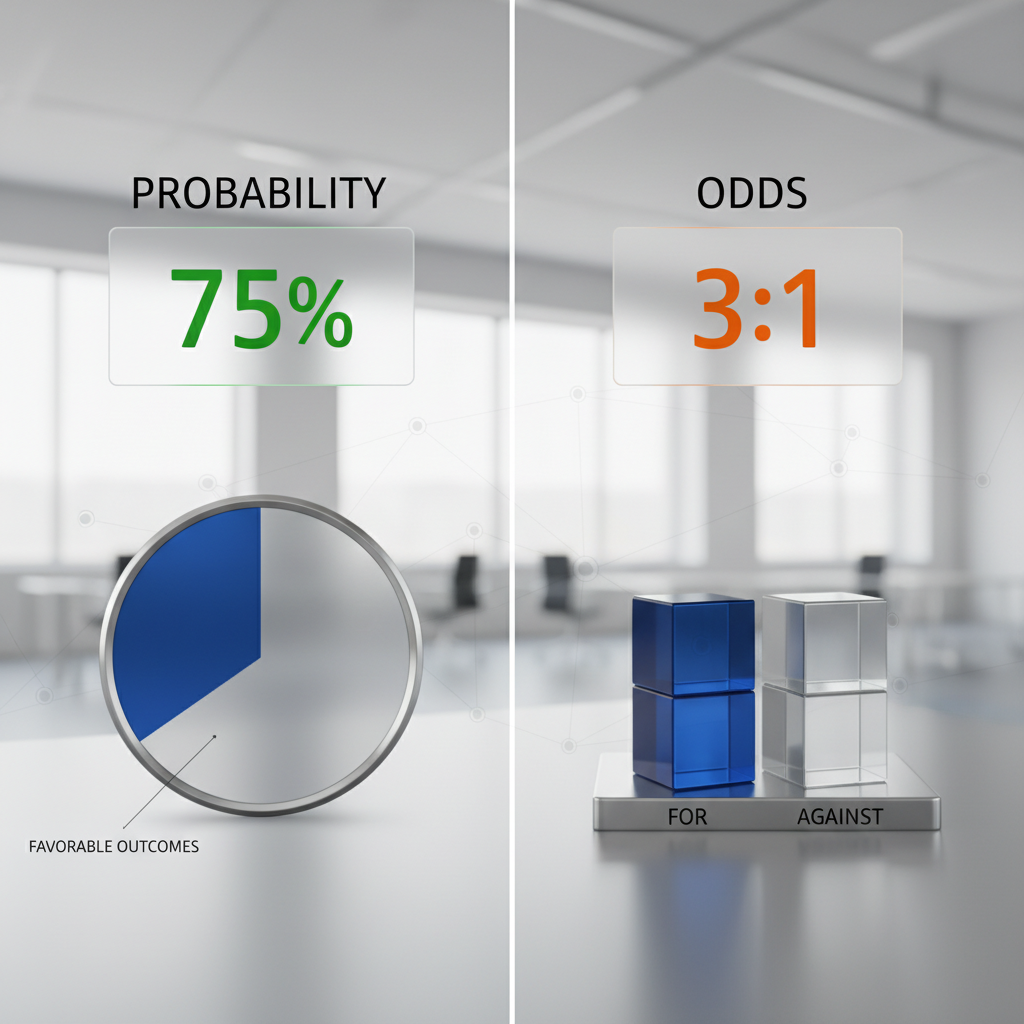
Odds are a way to show how likely an event is. They compare the number of favorable outcomes to the number of unfavorable outcomes. Sometimes, this is reversed to compare unfavorable outcomes to favorable ones. Understanding this difference is key.
For example, if the odds of winning are 1-to-2 (1:2), it means you have one chance to win and two chances to lose. This format is common in sports betting and games. Our odds percentage calculator helps you quickly understand these ratios.
Knowing how to read odds is useful in many areas, like statistics and risk assessment [2]. They provide a simple way to compare different outcomes.
Defining Probability: The Chance of an Outcome
Probability measures the chance that a single event will happen. It is shown as a fraction, decimal, or percentage. The value is always between 0 (impossible) and 1 (certain), or 0% and 100%.
To find probability, you divide the number of favorable outcomes by the total number of all possible outcomes. For example, the probability of flipping heads on a fair coin is 1/2, or 50%. This is because there is one way to get heads and two total outcomes (heads or tails).
Probability is a key part of modern statistics and data science [3]. It gives us a standard way to measure how certain or uncertain an outcome is.
Key Examples of Odds vs. Probability
The main difference is what they compare. Odds compare one part to another part (winning vs. losing), while probability compares one part to the total (winning vs. all outcomes). Our over 100 free calculator tools, including our odds percentage calculator, make these conversions straightforward.
Consider a simple scenario: rolling a standard six-sided die and wanting to roll a ‘4’.
| Concept | Explanation | Value |
|---|---|---|
| Favorable Outcomes | Rolling a ‘4’ | 1 |
| Unfavorable Outcomes | Rolling any number except ‘4’ (1, 2, 3, 5, 6) | 5 |
| Total Possible Outcomes | Rolling any number from 1 to 6 | 6 |
Based on these figures, we can clearly define both odds and probability:
- Odds: The odds of rolling a ‘4’ are 1:5. This compares the one way to win (rolling a ‘4’) to the five ways to lose. Our odds percentage calculator can easily convert these to percentages.
- Probability: The probability of rolling a ‘4’ is 1/6. This compares the one way to win to the six total possible outcomes. As a percentage, this is about 16.67%. Many of our calculators help convert probability to odds, and vice versa.
Knowing this difference is important for correct analysis, especially in betting. Both concepts are useful, but they describe an event’s likelihood in different ways.
How Do You Convert Odds to a Percentage Manually?
The Formula for Converting Odds to Probability
Odds and probability are two ways of looking at the chance of something happening. Odds compare the number of ways an event can happen to the number of ways it can’t. You can use a simple formula to turn odds into a probability.
If the odds for an event are A to B (or A:B), it means there are A ways for it to happen and B ways for it not to happen. The total number of possible outcomes is A + B.
The formula for the probability (P) is:
- P = A / (A + B)
Here’s what each part means:
- A: The number of ways the event can happen (favorable outcomes).
- B: The number of ways the event cannot happen (unfavorable outcomes).
- P: The probability, shown as a decimal between 0 and 1.
To turn this probability into a percentage, just multiply the decimal by 100. Our odds percentage calculator can also do this for you instantly.
Step-by-Step Example
Let’s walk through an example to see how the formula works.
Imagine a sports team has winning odds of 4:1 (four to one). This means for every 4 chances they have to win, there is 1 chance they will lose.
Here is how to turn those odds into a percentage:
- Identify A and B:
- In 4:1 odds, A (favorable outcomes) = 4.
- B (unfavorable outcomes) = 1.
- Apply the Formula:
- P = A / (A + B)
- P = 4 / (4 + 1)
- P = 4 / 5
- Calculate the Decimal Probability:
- P = 0.80
- Convert to a Percentage:
- Percentage = P * 100%
- Percentage = 0.80 * 100%
- Percentage = 80%
So, winning odds of 4:1 convert to an 80% probability of victory. While this calculation is simple, our odds percentage calculator provides an instant and reliable answer, especially for more complex numbers. It’s one of over 100 free professional calculators on eLearnSmart. [2]
How Does This Tool Work as a Betting Odds Calculator?

Understanding Implied Probability in Sports Betting
Implied probability is a key concept in sports betting. It turns betting odds into a simple percentage. This percentage shows the chance a bookmaker thinks an event has of happening. Our elearnsmart.com odds percentage calculator does this conversion for you instantly. It helps you understand the real probability of an outcome.
Bookmakers build a profit margin into their odds. This is often called the “vig” or “overround” [4]. Because of this margin, the implied probabilities for all outcomes in a single event will add up to more than 100%. That extra amount is how bookmakers make money. Our calculator shows you this hidden percentage, which is key for spotting good value bets.
Our tool gives you an edge by quickly translating complex odds. This lets you focus more on strategy. Understanding implied probability also makes it easier to compare odds from different betting sites.
Converting Different Odds Formats (Decimal, Fractional)
Betting odds come in several formats. The most common are Decimal and Fractional. Our elearnsmart.com calculator handles both formats with ease. This saves you time and prevents mistakes from doing the math yourself.
Here’s how our odds percentage calculator handles different odds:
- Decimal Odds: These are simple. They show the total payout for every $1 you bet. For example, odds of 2.50 mean a $1 bet pays out $2.50 in total. Our calculator uses the formula: (1 / Decimal Odds) * 100 to show you the implied probability.
- Fractional Odds: These show the potential profit you can make on your bet. For example, 5/1 odds mean you win $5 for every $1 you bet. Our tool instantly does the math for you using the formula: (Denominator / (Numerator + Denominator)) * 100.
It’s important to understand these formats, but converting them by hand can be tricky and lead to errors. Our odds percentage calculator ensures you get accurate, instant results. This lets you focus on your betting strategy, confident that the numbers are right.
Calculating Potential Payouts
Our odds percentage calculator mainly turns odds into a percentage, but this is also the first step to calculating payouts. Understanding an outcome’s true chance helps you judge a bet’s value and what you could win.
Here’s how our calculator helps you estimate payouts:
- Find Value Bets: Our tool shows you the implied probability from the bookmaker. If you think the actual chance of something happening is higher than what the odds suggest, you’ve found a value bet. Spotting these is key to betting profitably over time [5].
- Make Smarter Decisions: After seeing the implied probability, you can compare it to your own prediction. If your estimated chance is higher, it might be a good bet. You can then use the odds and your stake to figure out the potential payout.
- Evaluate Odds Quickly: Our calculator gives you the percentage in an instant. This speed lets you check many different bets and markets quickly. You can then figure out potential payouts and adjust your strategy on the fly.
In short, the elearnsmart.com odds percentage calculator gives you the key information you need. It helps you make smarter decisions and get a better idea of your potential winnings.
Frequently Asked Questions
What is the implied probability formula?
Implied probability converts betting odds into a percentage. It shows the chance of an event happening. This concept is key to making smart choices, especially in sports betting.
The formula changes slightly based on the odds format:
- For Decimal Odds: Implied Probability = (1 / Decimal Odds) * 100%
- For Fractional Odds (a/b): Implied Probability = (b / (a + b)) * 100%
- For Moneyline Odds (Positive +X): Implied Probability = (100 / (X + 100)) * 100%
- For Moneyline Odds (Negative -X): Implied Probability = (X / (X + 100)) * 100%
Our odds percentage calculator makes these complex calculations simple. You can use it to quickly find the implied probability from any common odds format. This helps you see the real risk and reward of a bet without doing the math yourself. Our platform has over 100 free tools to make these conversions easy.
Financial analysts also use implied probability for market predictions and risk assessment [1].
How do you convert probability to odds?
Converting probability to odds is a basic skill. It helps you see the chance of an event in a new way. This is useful when comparing your own predictions to the official odds.
There are two main ways to turn a probability into odds:
- Odds For (or Odds On): This is the ratio of success to failure.
- Formula: Odds For = P / (1 – P)
- Here, P is the probability of the event happening.
- Odds Against: This is the ratio of failure to success.
- Formula: Odds Against = (1 – P) / P
- This is often written as “X to Y.”
Let’s consider an example. If the probability of an event is 0.25 (25%), then:
- Odds For: 0.25 / (1 – 0.25) = 0.25 / 0.75 = 1/3. So, 1 to 3.
- Odds Against: (1 – 0.25) / 0.25 = 0.75 / 0.25 = 3/1. So, 3 to 1.
Our odds percentage calculator does this conversion for you instantly. It turns probabilities into different odds formats. This saves you time and ensures you get it right, helping you better understand the chances. The eLearnSmart platform offers many free tools for all your calculation needs.
How do you use a betting odds calculator?
A betting odds calculator is a powerful tool. It changes different odds formats into implied probabilities and potential payouts. Using it well can greatly improve your betting strategy.
Here are the steps to use a betting odds calculator:
- Select Odds Format: First, choose the type of odds you have. Common options are Decimal, Fractional, or Moneyline (American) odds.
- Input Your Odds: Enter the odds for the event. For example, if using fractional odds, you might enter ‘5/2’. For decimal, ‘3.50’. For moneyline, ‘+250’ or ‘-150’.
- Enter Your Stake (Optional): Many calculators let you enter your bet amount. This helps calculate your potential payout.
- View Results: The calculator will instantly show you key information. This includes the implied probability of the event, your potential profit, and your total payout.
Our betting odds calculator is easy to use. It helps you quickly compare odds from different bookmakers. It also helps you find value bets by comparing the implied probability to your own prediction. This is just one of over 100 free professional calculators on eLearnSmart.
What is a 10 to 11 odds calculator used for?
You will often see “10 to 11 odds” in betting. It represents a very close contest. With 10 to 11 odds (or 10/11), you must bet 11 to win 10.
Our odds percentage calculator helps you understand these specific ratios:
- Calculating Implied Probability: For 10/11 fractional odds, the implied probability is (11 / (10 + 11)) * 100% = (11 / 21) * 100% ≈ 52.38%. This means the chance is slightly higher than 50%.
- Assessing Value: Bookmakers use these odds for events they think are evenly matched. It also accounts for the ‘vig’ (their commission) [6]. A calculator helps you decide if the odds are a good value compared to what you think will happen.
- Comparing with Other Odds: A calculator can quickly convert 10 to 11 odds. You can then compare it with decimal (e.g., 1.909) or moneyline odds (e.g., -110) from other sources.
Our odds percentage calculator handles all fractional odds. It easily handles ratios like 10 to 11. This ensures you always have the exact percentage you need. Explore this and over 100 other free tools on eLearnSmart.
Sources
- https://www.investopedia.com/terms/i/impliedprobability.asp
- https://www.investopedia.com/terms/o/odds.asp
- https://mathworld.wolfram.com/Probability.html
- https://www.investopedia.com/terms/o/overround.asp
- https://www.paddypower.com/betting-calculator/what-is-value-betting
- https://www.britannica.com/money/vigorish
